
Learn CPR, Save a Life: A Complete Guide to the Skill That Protects Humanity
There are moments in life when just one action, one decision, or even one correctly performed movement can determine whether a person lives or dies. In the medical world, CPR (Cardiopulmonary Resuscitation) is that one skill — simple to learn, easy to perform, yet powerful enough to save countless lives each year.
Across the globe, more than seven million people die annually from sudden cardiac arrest, many of whom could have survived if someone nearby had known CPR.
This blog dives deep into the importance of CPR, its global rise, why it must be learned by everyone (not just doctors), and how performing it correctly can significantly increase the chances of survival.
The Global Rise of CPR Awareness
In 2014, the British Islamic Medical Association (BIMA) initiated CPR training within mosques and Islamic centers — a remarkable step that brought lifesaving skills into community spaces. Inspired by this initiative, Islamic Medical Associations from more than 12 countries adopted similar programs.
To honor this life-saving effort, the last week of September is now internationally observed as “Life Savers Week.”
The goal is simple yet profound:
“Train every ordinary person to perform extraordinary help in extraordinary moments.”
By democratizing CPR knowledge, millions of people—men, women, elders, and even teenagers—can learn to respond confidently during cardiac emergencies.
Why CPR Matters More Today Than Ever Before
Heart diseases have become the leading cause of death worldwide. According to the World Health Organization (WHO):
-
Cardiac arrests and heart-related complications are rising rapidly.
-
Deaths due to heart disease have increased more dramatically in Asia compared to any other region.
-
The majority of cardiac arrests occur outside hospitals, reducing survival chances drastically.
In Pakistan alone:
-
Every hour, 146 people die due to heart disease.
-
Just three years ago, the number was only 12 per hour — showing a shocking fourfold increase.
-
77% of cardiac arrests occur outside hospitals — at home, in markets, workplaces, or public places.
-
In 93% of these cases, a family member or friend is present, but tragically,
-
Only 10% survive because most bystanders do not know CPR.
These numbers tell a heartbreaking truth:
People are dying not because help is unavailable — but because help is untrained.
This is why global medical bodies strongly advocate that CPR be included in school and university curricula and should become a mandatory life skill for every individual.
Understanding Sudden Cardiac Arrest
A cardiac arrest is different from a traditional heart attack.
In simple terms:
-
A heart attack usually occurs due to blocked arteries.
-
A cardiac arrest is when the heart suddenly stops beating.
When this happens:
-
The person collapses
-
Breathing stops
-
Pulse disappears
-
The brain receives no oxygen
Brain damage begins within 3 minutes, and death can occur within 10 minutes.
CPR becomes the difference between life and death during this critical window.
What Exactly Is CPR?
CPR stands for Cardiopulmonary Resuscitation.
It is an emergency procedure that combines:
-
Chest Compressions
(to manually pump the heart and keep blood flowing) -
Rescue Breaths (optional)
(to supply oxygen to the lungs)
Modern guidelines now emphasize compression-only CPR for untrained individuals, as it is easier, safer, and still very effective.
CPR Saves Thousands of Lives — If Performed Immediately
Global studies reveal:
-
When CPR is done within the first 2 minutes, survival rates double or even triple.
-
Without CPR, every passing minute decreases survival chances by 10%.
Doctors often say:
“The first responder is the most important doctor in the world — even if they are not a doctor.”
Basic Life Support (BLS): The Foundation of CPR
The first step of CPR is called Basic Life Support (BLS).
Its purpose is simple:
keep oxygen flowing to the brain and vital organs until medical help arrives.
Doctors know from research:
-
If the brain is deprived of oxygen for 3 minutes → Cells start dying.
-
At 10 minutes without CPR → Death becomes likely.
This is why CPR must begin immediately when someone stops breathing or collapses due to cardiac arrest.
Real-Life Stories: CPR Truly Works
Doctors frequently witness cases where:
-
A husband saves his wife
-
A child saves a grandparent
-
A teenager saves a schoolmate
Simply because they received CPR training.
In many hospitals, including Pakistan, patients brought in with early CPR show much higher survival and recovery rates compared to those who didn’t receive any first response.
This is why CPR is often called:
“The gift of life that anyone can give.”
Types of CPR
There are three primary types of CPR:
-
Adult CPR
-
Child CPR (different hand pressure)
-
Infant CPR (very gentle compressions with two fingers)
This blog focuses mainly on adult CPR, as cardiac arrest is most common in adults.
How to Perform CPR: A Step-by-Step Guide
Here is the simplest and most effective guide for the average person, based on international standards:
STEP 1: Check for Responsiveness
-
Tap the person’s shoulder.
-
Call out loudly: “Are you okay?”
-
Observe any movement, breath, or reaction.
If they respond — stay with them and call for help.
If there is no response — proceed immediately.
STEP 2: Call Emergency Services
Dial:
📞 Rescue 1122 (Pakistan)
📞 Any local ambulance service
Call loudly for help around you:
“Someone call an ambulance!”
STEP 3: Position the Person Correctly
-
Lay them on their back on a firm surface.
-
Tilt their head slightly to open the airway.
-
Check for breathing for not more than 10 seconds.
If there is no breathing, continue to Step 4.
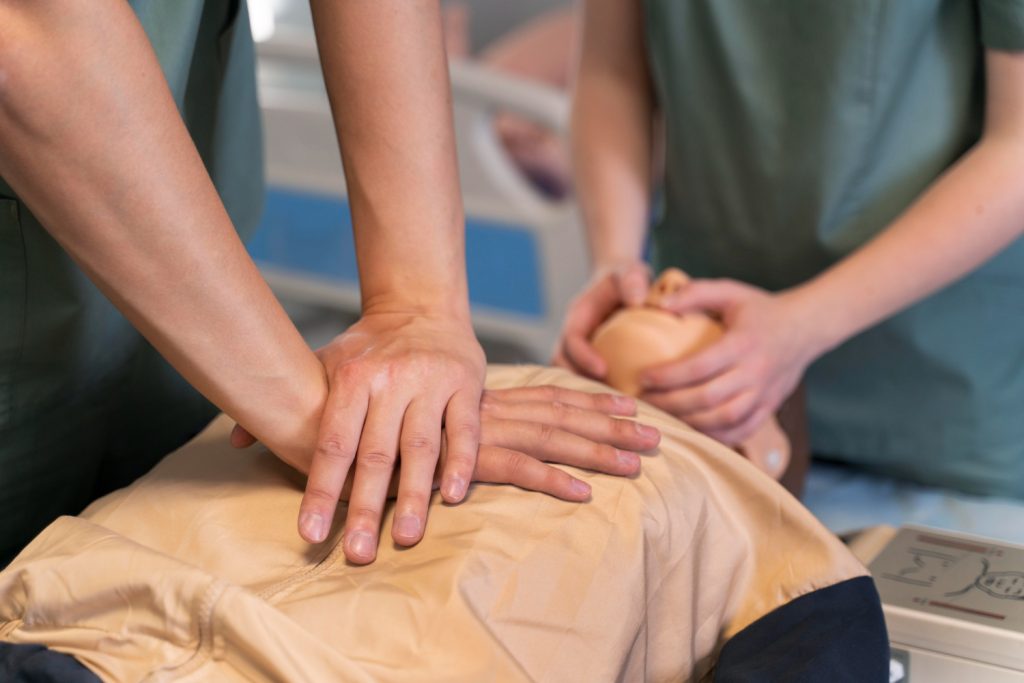
STEP 4: Start Chest Compressions
This is the most important part.
-
Place one hand at the center of the chest.
-
Place the second hand on top.
-
Interlock your fingers.
-
Lean forward with straight arms.
-
Push hard and fast.
Compression Guidelines
-
Press at least 4–5 cm deep
-
Rate: 100–120 compressions per minute
-
Same rhythm as the song “Stayin’ Alive”
This keeps blood flowing to the brain.
STEP 5: Give Rescue Breaths (Optional)
If trained:
-
After 30 compressions
-
Tilt the chin up
-
Give 2 rescue breaths
If untrained, skip this step and continue compression-only CPR.
Continue Until:
-
The person starts breathing
-
Medical help arrives
-
You become too exhausted
-
There are clear signs of death
Why Training Is Essential
This guide can help, but true confidence comes only after practical training.
A complete CPR workshop includes:
-
Theoretical explanation
-
Hands-on demonstration
-
Students practicing on mannequins
The best part?
Anyone can learn CPR — men, women, teens, elders.
Some training programs teach even 10- and 12-year-old children, and they perform wonderfully.
CPR: A Human Responsibility
We live in a time where emergencies can happen anywhere — homes, schools, offices, streets, or places of worship. In such moments, CPR transforms ordinary bystanders into heroes.
This simple skill gives you the power to prevent a tragedy, protect a family, and save a human life.
“When a heartbeat stops, the hands that act become the hands of God’s mercy.”
This is the essence of CPR — a universal language of compassion, kindness, and courage.
Final Thoughts
CPR is not just a medical technique.
It is a duty,
a life-saving gift,
and a skill every human should learn.
By learning CPR, you are not just prepared to save a stranger —
you may save your parent, your child, your spouse, or someone you love deeply.
So take the step today:
Attend a CPR training session. Learn the skill. Spread the awareness.
Because one day, your hands may be the only barrier between life and death.